Artificial Grass vs. Sod: Cost, Maintenance, Water Use & Long-Term Value

Emily Greenfield
September 18, 2026
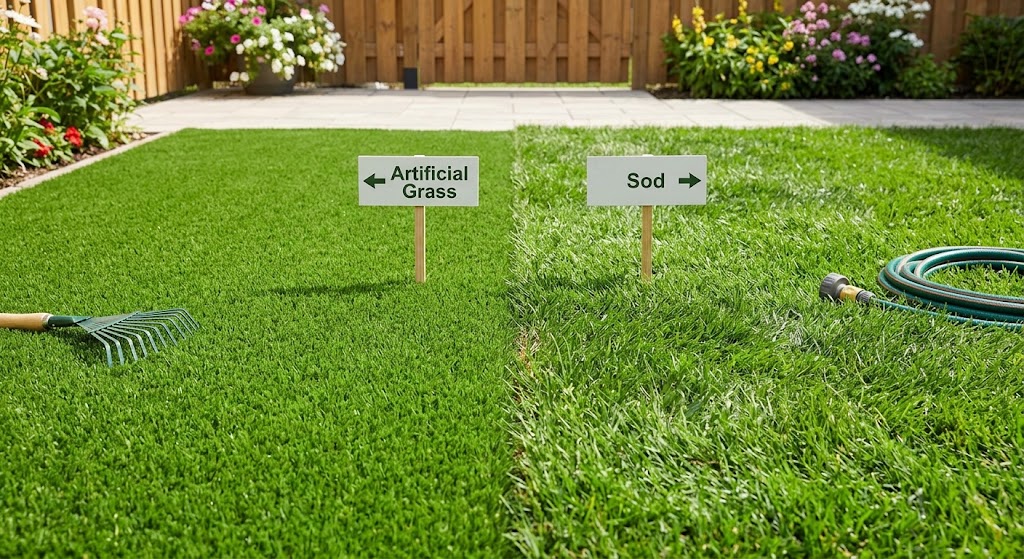

You’re standing in your bare backyard trying to decide between two very different paths to a green lawn. Sod gives you instant, natural-looking grass. Artificial grass gives you a lawn that looks the same on day one and day one thousand. It comes down to what you’re optimizing for: lowest upfront cost, least ongoing work, or the best return over the next decade.
Both options can get you a green yard by next weekend. What happens after that first month is where the real differences show up, in your water bill, your Saturday mornings, and the total amount of money you spend over the life of the lawn. Here’s how artificial grass vs sod actually compares across cost, maintenance, water use, and long-term value.
Sod wins on day one. Professionally installed sod runs about $1 to $3 per square foot in most markets, with a national average around $1.65 per square foot once you include the sod itself, delivery, basic soil prep, and labor. For a typical 2,000 square foot yard, that puts sod installation somewhere between $2,000 and $6,000.
Artificial grass costs more upfront. Installed pricing typically falls between $8 and $15 per square foot for mid-quality turf, and can run higher for premium materials or complex, curved layouts. That same 2,000 square foot yard could cost $16,000 to $30,000 to convert to synthetic turf.
That gap is real, and it’s the single biggest reason people default to sod without looking further. But cost per square foot on install day only tells you what you pay once. It doesn’t tell you what either lawn costs you every year after that, which is where the comparison starts to shift.
If you’re weighing the numbers for your own yard, Festival Turf offers a free sample so you can see the material quality before comparing it against a sod quote.
Sod needs ongoing work to stay looking like the lawn you paid for. Weekly mowing during the growing season, regular fertilization, weed control, aeration, and occasional reseeding all factor into a healthy lawn. Full-service professional lawn care, the range used in the cost comparisons below, typically runs $1,200 to $4,000 per year depending on lawn size and service level, and even a DIY approach still costs $200 to $600 annually in fertilizer, weed control, and equipment, on top of your own time.
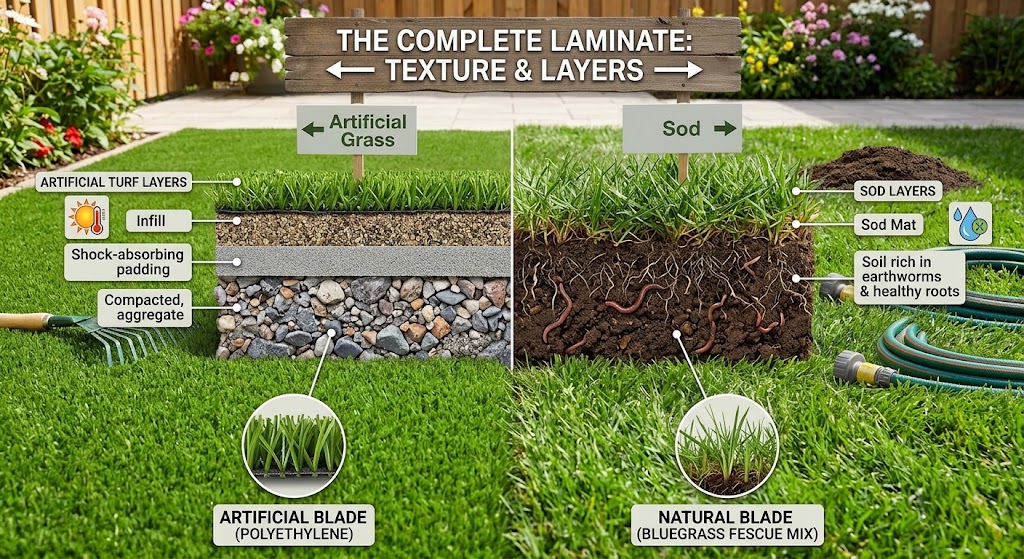
Artificial grass needs almost none of that. There’s no mowing, no fertilizing, no reseeding bare patches, and no weekly weed control. Maintenance is mostly limited to an occasional rinse to clear debris and a light brushing to keep the fibers standing upright, especially in high-traffic areas. For pet owners, that also means no muddy patches or urine-burned spots to fix every spring.
Over five years, sod’s maintenance costs alone can add up to $6,000 to $20,000, on top of the original installation. Artificial grass’s maintenance cost over that same period is close to zero.
This is where the comparison changes the most for anyone in a drought-prone market. A standard 1,000 square foot natural grass lawn needs roughly 35,000 to 75,000 gallons of water per year to stay healthy, depending on climate and irrigation efficiency, according to data from the Association of California Water Agencies. The Southern Nevada Water Authority estimates homeowners can save up to 50 gallons of water per year for every square foot of natural grass replaced with synthetic turf.
For a 1,000 square foot yard, that’s a potential savings of 50,000 gallons of water annually just from switching. In markets like Las Vegas, Phoenix, and Southern California, where water rates keep climbing and rebate programs exist specifically to reduce turf irrigation, that water savings often do more to justify artificial grass than the maintenance savings alone.
Sod, even drought-tolerant varieties, still needs regular irrigation to establish and survive. Artificial grass needs none. If you’re in a Sun Belt market and want to see how that plays out locally, our Las Vegas showroom team can walk you through current water district rebate options in your area.
Sod is cheaper to install but keeps costing money every year afterward, in water, fertilizer, mowing services, and eventual patch repair or replacement as sections die off or wear thin. Over a 15 to 20 year period, those annual costs typically exceed the original installation price several times over.
Artificial grass costs more to install but essentially stops costing you money the day it’s down. With a lifespan of 20 to 25 years when properly maintained, the total cost of ownership often becomes lower than sod somewhere between year 5 and year 8, once you account for eliminated water bills, mowing services, and fertilizer.
Festival Turf backs every product with a 15-year warranty, which protects that investment for most of the lawn’s expected lifespan. If sod fails, dies, or develops bare patches, you’re paying to fix or replace it yourself with no equivalent guarantee.
If you’re planning to sell your home within a year or two and want the lowest possible upfront cost, sod is the more conservative choice. It’s a familiar look to most buyers and doesn’t require explaining a product category some people are still unfamiliar with.
If you’re staying in your home for the next 5+ years, live somewhere hot or dry, have pets, or are simply tired of weekend yard work, artificial grass is very likely the better long-term value. The upfront cost is the trade-off you’re making in exchange for two decades of no watering, no mowing, and no dead patches.
Contractors and landscapers weighing this for clients should factor in local water rebate eligibility, since that can materially shift a client’s break-even timeline in states like Nevada and California. Our team can walk through bulk pricing and product options for larger commercial or residential areas.
If you want a fuller comparison between artificial grass and natural grass generally, not just sod specifically, our turf vs. grass guide covers appearance, feel, and environmental factors in more depth.
Yes, in most cases. Sod costs less upfront, but ongoing water, mowing, and fertilizer expenses typically make artificial grass the lower total cost option within 5 to 8 years, especially in areas with high water rates.
Homeowners can save up to 50 gallons of water per year for every square foot of natural grass replaced with artificial turf, based on Southern Nevada Water Authority estimates. For a typical 1,000 square foot lawn, that’s roughly 50,000 gallons saved annually.
Properly installed artificial grass typically lasts 20 to 25 years. Sod requires ongoing renewal through reseeding, patching, and regular care, and individual sections can die off or need replacement well before that timeframe if not consistently maintained.
Yes, often more so than for a large yard. Smaller spaces make the higher per-square-foot cost of artificial grass more affordable in total dollars, while still delivering the same water savings percentage and eliminating the mowing hassle that’s disproportionately annoying in tight spaces.

 Artificial Grass Around Trees: What Homeowners Should Know