Drought-Tolerant Landscaping Ideas for Dallas Homes

Emily Greenfield
April 21, 2026
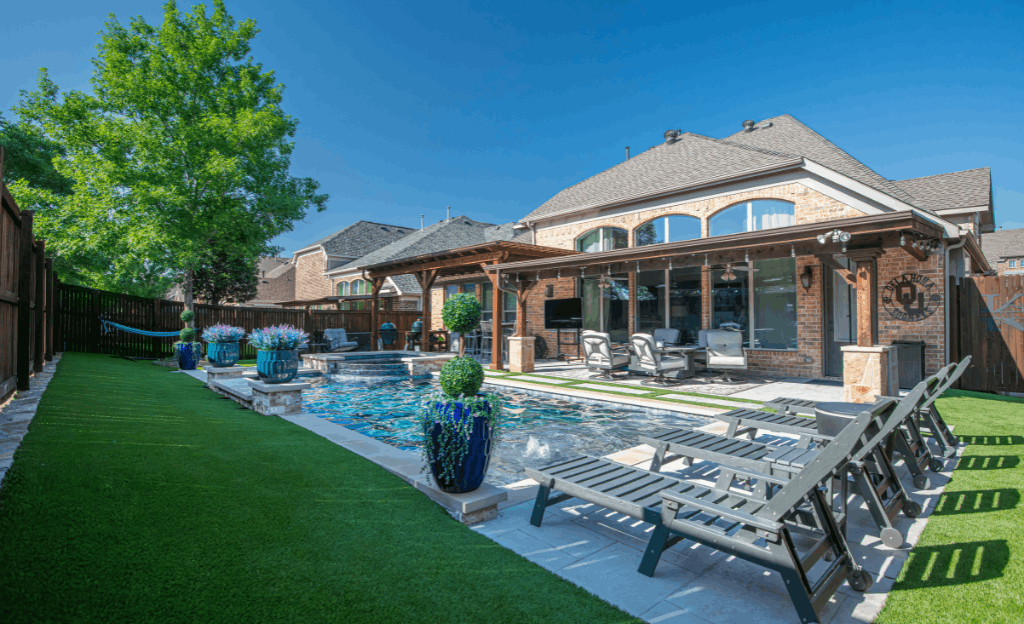

Dallas summers aren’t easy on lawns. When temperatures sit above 100°F for weeks and drought conditions stick around year after year. You might already be seeing brown patches or noticing your water bill creeping up.
At that point, it’s worth considering a different approach. Drought-tolerant landscaping in Dallas isn’t about giving up on a nice-looking yard, it’s about building something that actually survives the heat without constant upkeep and heavy watering.
From replacing thirsty grass to fixing problem areas, there are a few smart ways to make your outdoor space work better for North Texas weather.
Before looking at solutions, it’s important to understand why regular grass struggles here. It’s not just a maintenance issue you can fix with more watering, the climate itself is the problem.
North Texas summers combine extreme heat with intense UV exposure. Most cool-season grasses can’t survive it at all, and even warm-season varieties like Bermuda and St. Augustine go dormant or die back when ground temperatures stay elevated for weeks. Established turf can require daily irrigation just to stay alive during peak summer months.
Water rates across the DFW metro have increased significantly over the past decade, and drought restrictions regularly limit outdoor watering schedules. The Dallas Water Utilities has issued Stage 1 and Stage 2 watering restrictions in multiple recent summers, limiting outdoor watering to two days per week or less. A traditional lawn that needs three to four inches of water per week is simply not compatible with those conditions.
Even if you manage to keep a natural lawn alive in Dallas heat, it takes a lot of ongoing work, mowing, fertilizing, aerating, and dealing with pests almost year-round. Between the time it takes and the cost of water and maintenance, a traditional lawn quickly becomes one of the most demanding parts of a Dallas home.
The good news: you have a lot of options. Drought-tolerant landscaping is not just about cactus and gravel. Done well, it produces a yard that looks great, requires minimal upkeep, and holds up through the worst of a Texas summer.
Artificial grass in Dallas is one of the most effective solutions because it removes the biggest challenge entirely: the need for constant watering and ongoing lawn recovery during extreme heat.
Modern synthetic turf is designed to stay green year-round and can handle heavy use from kids, pets, and regular foot traffic. Many systems also include high drainage rates, helping rainwater pass through quickly instead of pooling on the surface. UV-stabilized fibers help reduce fading in strong Dallas sun conditions.
If you’re exploring this option, there are different grades available depending on use, from standard residential installs to more durable pet-friendly systems.
Native Texas plants are adapted to the local climate and soil, which means they’ve been handling Dallas summers for thousands of years without irrigation assistance. Once established, plants like Texas sage, lantana, black-eyed Susan, and Mexican feathergrass need minimal supplemental watering.
Combining native plants with artificial turf or decorative gravel creates a layered, visually interesting yard that reads as intentionally designed rather than just low-maintenance. A local nursery or landscaper familiar with North Texas conditions can help you choose species that work with your specific sun exposure and soil type.
Decomposed granite, river rock, and flagstone are all popular choices in Dallas drought-tolerant yards. These materials don’t require any watering, and when installed properly with landscape fabric, they also help reduce weed growth.
Unlike traditional grass, they don’t break down or turn patchy in extreme heat. Instead, they hold their structure and help create a more consistent, low-maintenance surface that works well in Dallas conditions.
Rock and gravel are especially useful in high-traffic areas or along borders where grass typically struggles to grow. When paired with drought-resistant plants, they also add contrast and natural texture to the landscape.
In planted areas, adding a 3 to 4 inch layer of shredded hardwood or cedar mulch significantly reduces soil moisture loss. It also insulates plant roots from extreme heat, suppresses weeds, and slowly breaks down over time to improve soil quality.
As a result, this becomes a cost-effective way to reduce irrigation needs in garden beds without replacing existing plants. In particular, it works especially well around trees and shrubs that would otherwise require frequent deep watering during the summer.
One of the most effective drought-tolerant landscaping strategies is reducing the amount of turf or planted area and replacing part of it with functional hardscape. A patio, deck, or pergola combined with low-water plantings and a section of synthetic turf can create a usable outdoor space that requires very little maintenance.
For homeowners considering more specialized upgrades, putting greens is another popular option in Dallas. Festival Turf also installs putting greens designed for backyard use.
Artificial turf works as both a full lawn replacement and a solution for problem areas. Some fake grass works as both a full lawn replacement and a solution for problem areas. Some homeowners replace the entire yard. Others only fix sections and mix turf with gravel, native plants, and hardscape.
In drought-tolerant yards, artificial grass is used for pool surrounds, front lawns, side yards, play areas, and pet runs. In many cases, it performs better than natural grass in compacted clay soil, which is very common in North Texas. As a result, homeowners don’t have to rely on constant watering just to keep grass alive.
In addition, artificial grass stays usable in shaded areas and doesn’t heat up as quickly there. For full-sun spots, cooling infill can help reduce surface heat. Because of this, it works well across different zones of a yard, not just one area.
The most immediate financial benefit is water savings. A natural lawn in North Texas can account for 30 to 50 percent of a household’s total water use during summer. Replacing lawn with artificial grass or drought-resistant alternatives eliminates that usage almost entirely.
Drought-tolerant yards require a fraction of the ongoing work of a conventional lawn. No weekly mowing, no seasonal reseeding, no fertilizer schedules. Artificial turf needs an occasional rinse and a brush to keep blades upright. Native plant beds need seasonal pruning and mulch refreshing — that’s about it.
Water conservation is increasingly important across Texas as the state’s population grows and aquifer levels in some regions decline. A drought-tolerant yard reduces your household’s pressure on municipal water supply and positions your property well ahead of any future mandatory watering restrictions.
Traditional lawns look their worst exactly when neighbors and visitors are spending the most time outdoors during summer. A drought-tolerant landscape maintains its appearance through July and August when natural grass is stressed or dormant, giving your home consistent curb appeal in every season.
Drought-tolerant landscaping is one of the best long-term investments a homeowner can make in Dallas. Whether you go all-in with artificial turf or build a mixed yard using multiple strategies, the result is a yard that holds up in North Texas conditions without draining your time or water budget. Festival Turf’s Dallas-area artificial turf showroom in Garland lets you see the product before you buy. You can also order free turf samples delivered to your door, a good way to compare options before committing to any installation.

 Phoenix Backyard Ideas: Why Artificial Turf Beats Grass in the Heat