Best Playground Surface Options: Natural vs Artificial Turf vs Rubber

Emily Greenfield
April 8, 2026

The surface under a playground rarely gets as much attention as the equipment above it. That’s a mistake. It’s the layer that catches a child falling from six feet. It’s also the detail parents overlook until after something goes wrong.
Evaluating playground surface options comes down to three real questions. How high is the equipment? Who is using this space regularly? How much maintenance are you realistically prepared to keep up with? We have answered those questions surface by surface, covering where each performs, where it falls short, and how to match the right material to the right space.
Fall protection is the primary function any playground surface must deliver. According to the CPSC Public Playground Safety Handbook, falls to the surface account for the large majority of playground injuries. Equipment failure is rarely the cause.
Every tested surface is evaluated for impact attenuation, which measures its ability to reduce the force of a fall before it reaches the body. Surfaces without independent certification do not deliver that protection reliably, regardless of how they feel underfoot. Certification is the baseline, not a bonus.

The three surfaces that dominate most playground specifications are natural grass, artificial turf, and rubber. Each has a different performance profile. The right choice depends more on how the space is actually used than on any single factor in isolation.
Natural grass is the default for most residential yards. It’s familiar, inexpensive upfront, and visually comfortable. The performance problem shows up fast.
Grass compacts quickly in high-traffic zones, and landing areas beneath swings or at the base of slides often lose their shock absorption within a single season. Bare patches tend to appear precisely where protection is most needed. Comparing artificial turf vs. natural grass highlights how synthetic surfaces maintain cushioning and durability far better over time. While natural grass can be suitable for casual residential use with modest equipment, surfaces that see consistent use deteriorate far faster than most homeowners expect.
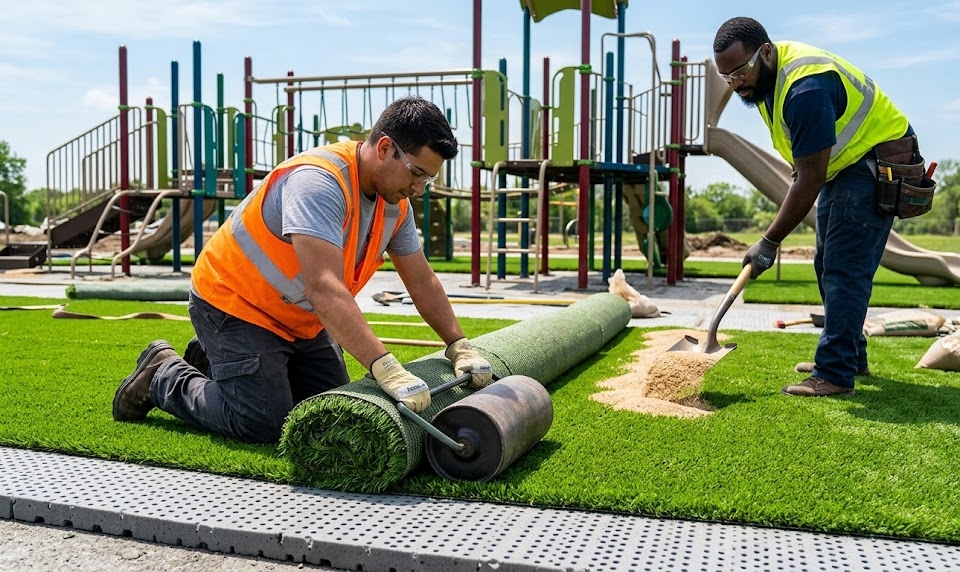
Artificial turf has become one of the most specified outdoor playground surface options for schools, parks, and residential projects. The performance case of artificial grass for playgrounds depends entirely on the system, not just the surface material.
A properly installed playground turf system includes a cushioned pad beneath the turf, an infill material to support blade structure and soften impact, and a drainage layer that clears water quickly after rain. A weed barrier beneath the compacted base stabilizes the system over time.
Together, these components allow quality turf systems to meet the fall protection benchmarks required for ADA compliant surfacing and carry IPEMA certified ratings across a wide range of critical fall heights. That certification matters in practice because a turf surface without a tested underlayment provides no guaranteed protection at any given drop height.
Festival Turf’s artificial grass products include options built for playground applications, non-toxic and lead-free, with drainage systems engineered for active use.
Poured-in-place rubber is the most durable form of rubber surfacing. It’s a two-layer system applied over a compacted base, with a wear surface on top and a shock absorption layer beneath. It consistently meets ASTM safety standards across high fall heights and handles institutional use without the replacement cycles that loose-fill materials require.
Rubber tile systems offer comparable safety performance at a lower upfront cost but can gap or shift without regular professional maintenance. Cost and heat are the primary tradeoffs. Poured-in-place rubber sits at the top of the price range for playground surfaces. In warm climates, rubber absorbs and holds solar heat longer than turf in direct sun. That’s a real consideration for Southwest installations and similar high-sun environments.
Several loose-fill and granular materials also serve as ground surfacing options under playgrounds. None match the long-term performance of unitary surfaces, but each fills a specific use case when budget or application calls for it.
Engineered wood fiber is the most widely used loose-fill surfacing material for public playgrounds. The distinction from standard wood chips matters. Standard bark mulch is not processed to safety specifications and does not carry certified fall height ratings.
Engineered wood fiber is independently tested for fall height performance and can meet the same safety thresholds as rubber or turf when installed at the correct depth. It requires regular raking to maintain even distribution and periodic replenishment as it compacts over time. A properly placed weed barrier beneath the base layer slows contamination and extends surface life.
For residential playgrounds, sand offers sufficient cushioning when maintained at the correct depth. It’s soft, cost-effective, and easy to install.
Public and commercial playground use is a different matter. Current accessibility requirements do not permit sand in those settings. It compacts with use, migrates out of the play zone, and presents significant challenges for wheelchair users. For residential use, sand is a practical choice with real replenishment and maintenance demands attached.
Pea gravel drains well, does not decompose, and costs less than most alternatives. For residential applications with low-to-moderate equipment heights, it functions as a workable basic surface option.
Like sand, pea gravel does not meet public or commercial playground accessibility standards. It shifts under use, reducing depth coverage in high-traffic zones. For residential use it’s manageable, though ingestion risk and the ongoing need to redistribute the material are worth factoring in for families with young children.
| Surface | Safety certified | ADA accessible | Maintenance | Cost range | Lifespan |
|---|---|---|---|---|---|
| Natural grass | No | No | High | Low | Variable |
| Artificial turf (w/ pad) | Yes | Yes | Low | Medium–High | 15–25 yrs |
| Poured-in-place rubber | Yes | Yes | Low | High | 10–15 yrs |
| Engineered wood fiber | Yes | Yes | Medium | Low–Medium | 2–5 yrs |
| Sand | No | No (commercial) | High | Low | Ongoing |
| Pea gravel | No | No (commercial) | Medium | Low | N/A |
Three variables drive most playground surface decisions. First, the certified fall height required by the equipment. Second, the full lifecycle budget. Third, the site’s climate and drainage conditions. Getting any one of these wrong affects how the surface performs from the first season forward.
Start with the equipment height. Every surface needs to be rated against the critical fall height of the tallest structure on the playground. That number sets the minimum performance requirement for whatever material is chosen.
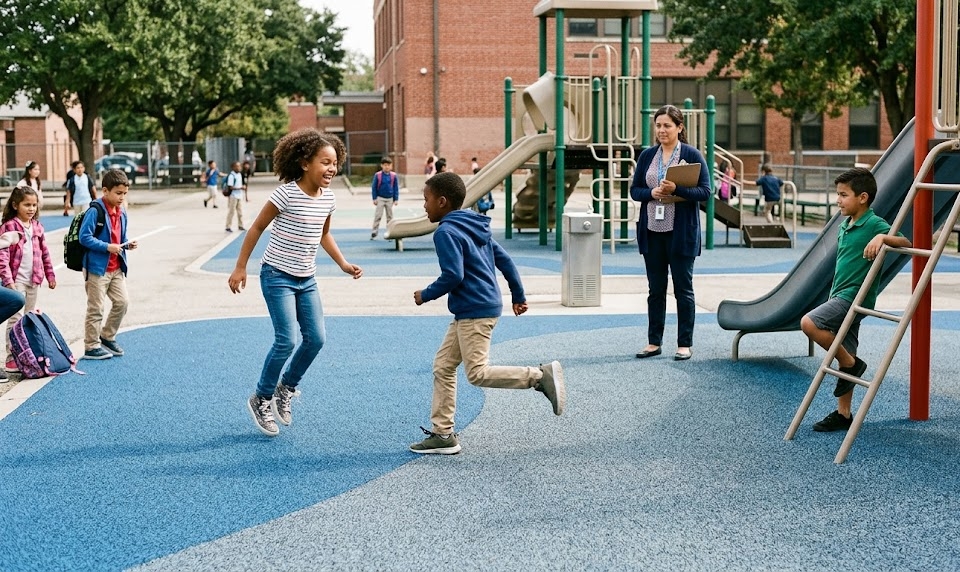
Options for playground surfacing that satisfy public or commercial accessibility requirements are limited to engineered wood fiber, artificial turf with proper padding, and rubber. Each can meet the fall height benchmark under ASTM safety standards. Cost, maintenance load, and climate fit are what separate them from there.
Upfront cost rarely tells the full story. Engineered wood fiber has the lowest initial outlay but requires replenishment every few years and ongoing labor to maintain even depth. Poured-in-place rubber carries the highest upfront investment but minimal long-term cost once installed. Artificial turf falls between those two poles, higher upfront than loose-fill but lower long-term than materials requiring regular replacement.
When comparing long-term performance and maintenance requirements, the benefits of playground turf become clear, including consistent cushioning, low upkeep, and durability under heavy use.
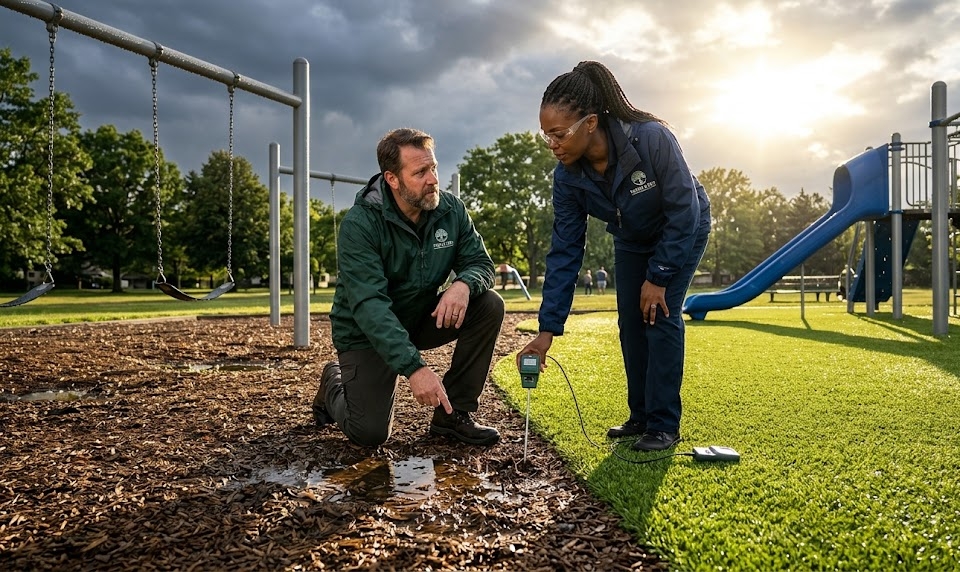
Drainage performance should be confirmed before selecting a surface, not after the first heavy rain. Loose-fill materials hold moisture and can develop mold in consistently wet climates. Rubber and turf systems with a proper drainage layer clear water faster, keeping the play area usable sooner after rain.
In hot, dry regions, heat retention is the more pressing variable. Rubber absorbs solar heat longer than turf in direct sun. Artificial turf with appropriate infill manages heat better in high-sun locations like Las Vegas. For Southwest installations, confirming how a surface performs during peak-temperature months is worth doing before committing. To discuss what the right system looks like for a specific site, get a playground turf quote from the Festival Turf team.
The questions below address the practical decisions most property owners are working through when comparing surface materials.
For most installations, artificial turf with a shock-absorbing pad or poured-in-place rubber delivers the strongest combination of safety, durability, and low maintenance. Both support accessibility compliance and meet certified fall height requirements. Playground surface options that perform best long-term are generally those specified as a complete system, pad, drainage, and infill together, not the surface material in isolation.
For most residential play areas, artificial turf is a strong choice. It’s soft underfoot and drains quickly after rain. It also handles residential fall heights reliably without the replenishment cycles that loose-fill materials demand. That said, if the budget is tight and the equipment is modest, engineered wood fiber is a reasonable alternative with a lower initial cost. The best outdoor playground surface options for a home yard balance fall protection with the level of maintenance you’ll realistically keep up with.
The safest surfaces are those independently tested and certified at the specific fall height of the equipment in use. Poured-in-place rubber and properly installed artificial turf with cushioned underlayment consistently meet those benchmarks. Certification matters more than surface type in isolation. The same material installed without proper depth or underlayment will fail where a certified system succeeds.
This depends on the context. Public and commercial spaces require accessibility-compliant surfaces such as turf, rubber, or engineered wood fiber. For residential backyard use, artificial turf is typically the most practical long-term choice. No replacement cycles. No bare patches forming under high-use equipment. Most homeowners working through this comparison end up there, unless a specific budget ceiling or unusual drainage condition changes the calculus.

 Artificial Hedge Wall Ideas for Home and Garden Spaces